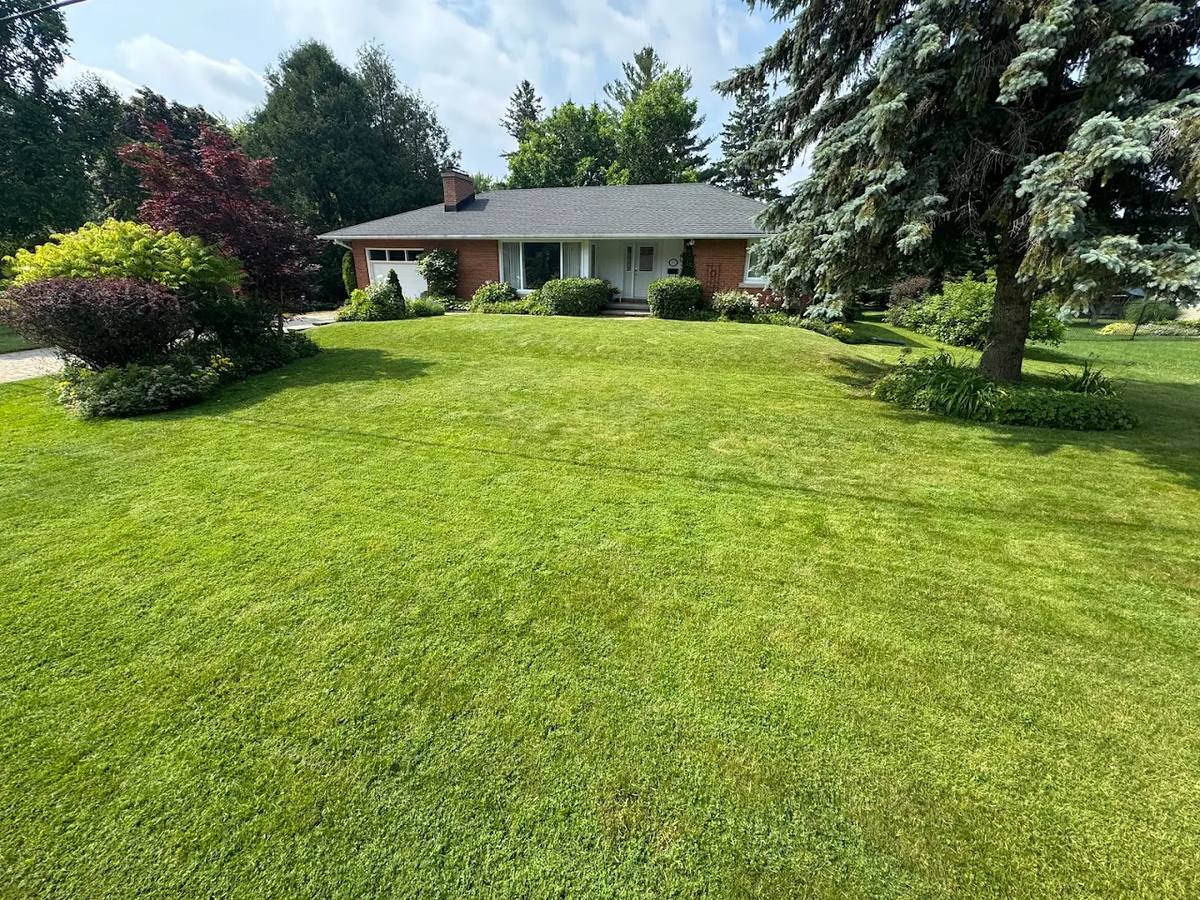
Thatch is the layer of dead stems, roots and runners that builds up between the soil and the green grass above it. A thin layer — under half an inch — is healthy; it cushions the crowns and holds moisture. Past that, it turns into a spongy mat that sheds rain, hoards fertilizer, and gives insects and fungus a place to live right on top of your roots.
Our dethatching service mechanically lifts that mat out with a power rake, hauls the debris away, and leaves the soil surface open. Because a dethatched lawn is the best seedbed you will ever have, most Guelph clients pair it with overseeding the same visit.
What's Included
The half-inch rule: how to check your own lawn
Cut a small wedge out of the lawn with a trowel and look at it side-on. Between the soil and the green blades you will see a brown, fibrous layer — that is thatch. Under half an inch, leave it alone. Over half an inch, and especially past an inch, it is costing you: water beads up and runs off, fertilizer never reaches the roots, and the lawn feels spongy underfoot.
Kentucky bluegrass lawns — the most common turf in Guelph — are the most thatch-prone because they spread by underground rhizomes. Lawns that get fertilized heavily every spring without ever being aerated are the ones we see with the thickest mats.
Dethatching vs. aeration: which one does your lawn need?
These get confused constantly, and the wrong one is wasted money. Aeration fixes compacted soil — hard ground, puddling, roots that cannot push down. Dethatching fixes a build-up on top of the soil. Do the screwdriver test (does it push in easily after rain?) and the wedge test together: hard soil means aerate; thick brown layer means dethatch; both means both, and we will sequence them properly.
If your thatch is borderline, core aeration alone often solves it — the soil plugs it pulls up contain microbes that break thatch down naturally. We will tell you which is the cheaper fix for your lawn, even when the answer is the less expensive service.
When to dethatch in Guelph
Dethatching is hard on a lawn for a couple of weeks, so it has to happen when the grass is actively growing and can recover: late August through September is ideal here, with spring (once the soil has firmed up in May) a solid second choice. Never in the heat of July, and never right before the lawn goes dormant for winter.
Common Questions
Service Area
Dethatching across all of Guelph — Kortright Hills, Clairfields, Westminster Woods, Hanlon Creek, Grange Hill East, Exhibition Park, St. George’s Park, Riverside Park and the surrounding neighbourhoods.
From our Guelph lawn care guides
- Aeration vs. dethatching: which does your Guelph lawn need? → — two five-minute tests that settle it
- Does my Guelph lawn actually need aeration? → — the 30-second screwdriver test
- Fall lawn care checklist for Guelph → — where dethatching fits in the sequence
Ready to get started?
Spots are filling fast for the 2026 season. Lock in your rate today.
Get a Free Quote →